
Insights · Body corporate & strata
The short answer. Published Australian cost guides put an average garden maintenance visit at $140 to $220 nationally, and $170 to $250 in Melbourne, inside a full published span of $60 to $600 that covers everything from a routine mow to a major clean-up. Owners corporations rarely buy gardening one visit at a time in any case. Most engage a fixed contract paid from the administrative fund, so the useful question isn't the per-visit rate. It's what a year of grounds care should cost for your type of complex.
What the market charges
Airtasker's garden maintenance cost guide, built from real job pricing across Australia, now prices the work per visit rather than per hour: $140 to $220 for an average maintenance visit nationally, $170 to $250 in Melbourne, with the full published span running $60 to $600 depending on size and condition. Its frequency table is the most useful part for committees: a weekly maintenance visit runs $60 to $120 and a fortnightly visit $80 to $160. The separate gardener guide agrees, putting most completed jobs at $150 to $220 nationally and $170 to $250 in Melbourne. The market quotes visits, not hours, which is exactly how fixed-fee strata work is bought.
The planning bands used for the arithmetic on this page are per visit, scaled by complex size: $80 to $150 for a small block, $140 to $220 for a mid-size complex, and $200 to $400 for a large multi-building site. Each band comes straight from the published size and frequency tables. The tops of the published ranges cover one-off and project work: big clean-ups, overgrown clearances, difficult access. A contracted recurring program usually lands in the lower half of its band, because travel, quoting and setup are spread across a year of visits rather than priced into one. Every worked example below uses these same bands, so the numbers stay consistent with each other.
It's worth knowing why a contractor's rate sits well above an employed gardener's wage. Under the Gardening and Landscaping Award, the minimum adult rate from 1 July 2026 runs from $26.44 an hour at Level 1 to $30.38 at Level 5. A contractor's rate has to carry that wage plus public liability insurance, machinery and fuel, a vehicle and trailer, travel between sites, green-waste disposal fees, superannuation and admin. A quote well below the market band usually means something in that list is not being paid for. Ask which one, and ask to see the Certificate of Currency.
Sources: Airtasker, garden maintenance cost guide (updated 18 June 2026) and Airtasker, gardener cost guide (updated 19 June 2026) for market pricing; Fair Work Commission, Gardening and Landscaping Award (MA000101) for minimum wage rates operative 1 July 2026. Marketplace figures are market indications, not quotes. Every site prices individually.
How owners corporations actually buy grounds care
For an OC, gardening is a line in the administrative fund (the same budget that carries insurance, cleaning and minor repairs) and it's approved by owners at the AGM. Committees and managers typically tender the work and engage a contractor on a fixed monthly or annual price for a defined scope, rather than paying by the hour. That structure exists for a good reason: levies are set annually, so the committee needs the grounds cost to be predictable twelve months out, whatever the weather does.
Visit frequency follows Melbourne's growing season. Most common-property programs run weekly or fortnightly from spring to autumn, stretching to fortnightly or monthly through winter when growth slows. A well-scoped contract builds that seasonality in, rather than charging the February visit rate in July.
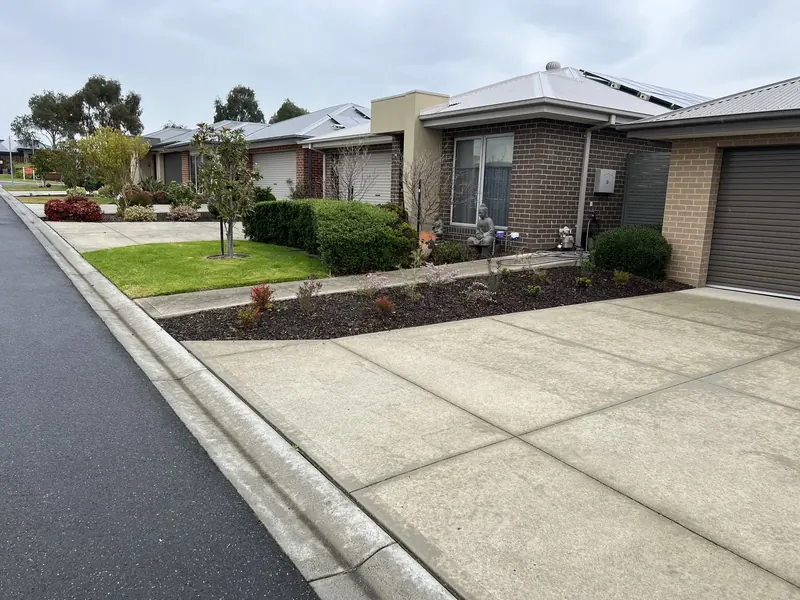
Indicative annual budgets by complex size
The honest way to turn a per-visit market rate into an annual figure is simple arithmetic: visits per year × the per-visit band for your complex size, set out above. Here's what that produces for three common complex types. These are illustrative calculations, not quotes, and real programs vary with everything in the next section.
- Small walk-up block : lawn, edges and a few beds, a short visit a fortnight: 26 visits × $80-$150 ≈ $2,100-$3,900 a year (roughly $175-$325 a month).
- Mid-size townhouse complex : shared lawns on a ride-on, hedges and entry beds, a solid fortnightly visit: 26 visits × $140-$220 ≈ $3,650-$5,700 a year (roughly $305-$475 a month).
- Larger multi-building site : weekly through the growing season, fortnightly in winter, about 38 visits a year: 38 visits × $200-$400 ≈ $7,600-$15,200 a year (roughly $635-$1,265 a month).
If a fixed-fee quote for your complex lands inside the band this arithmetic produces, it's priced on market. Confirm whether quotes are GST-inclusive when comparing.
Quick budget estimator
Pick the closest match and the estimator applies the market ranges published above. It is illustrative only. Real programs are quoted after a site walkthrough.
Seven things that move the price
- Lawn area and machinery. Open lawns a ride-on can cover cost far less per square metre than tight strips that need a push mower and line trimmer.
- Frequency and seasonality. A schedule tuned to growth (more in spring, less in winter) costs less over a year than a flat weekly schedule.
- Access. Locked gates, basement storage, tight corridors and stairs all add minutes to every single visit, forever.
- Hedging load. Long boundary hedges and screening plants are the biggest hidden variable. They're slow work and generate the most green waste.
- Green-waste volume. Disposal costs real money. Confirm removal is included, or the tidy quote leaves clippings in your car park.
- Reporting and compliance. Seasonal condition reports, insurance certificates and induction requirements take time; contractors who provide them price them in.
- Starting condition. A site that's been let go usually needs a priced catch-up visit before a recurring program can hold it.
Hourly or fixed fee?
Hourly suits one-off jobs. For an OC, fixed-fee wins on three fronts: the committee can budget levies against a known number, the seasonal risk sits with the contractor rather than the owners, and there's no incentive for visits to quietly stretch. The trade is that the scope has to be written properly (what areas, what frequency by season, and what's included) so both sides are pricing the same job.
Red flags in a cheap quote
A price well under the market band is usually missing something. The common gaps: no evidence of public liability insurance (ask for a Certificate of Currency, not a verbal yes), green waste excluded or dumped on site, no written scope so the job shrinks over time, travel or call-out fees added per visit, and no reporting, which means the committee is paying for work it can never verify happened. The cheapest quote that then generates complaints, chase-up emails and a mid-year contractor change is not the cheapest quote.
What to put in your tender or quote request
You'll get comparable, honest prices if every contractor is pricing the same thing. Ask for: a walkthrough before quoting; a written scope naming each area; visit frequency by season; inclusions spelt out (mowing, edges, hedges, beds, weed control, blowing, green-waste removal); a current Certificate of Currency; how the work is reported each visit; and references from comparable sites. For the full process, step by step, see our guide to tendering a grounds maintenance contract. And for what good looks like in writing, the Kanga Standard, our written promise, covers exactly these points.
Want a real number instead of a range? We maintain body corporate and strata common areas across south-east Melbourne and the Mornington Peninsula on fixed monthly fees, with seasonal condition reporting. See the body corporate service, or request a free walkthrough and quote, usually with a reply the same business day and rarely later than the next one.
Common questions
How much does body corporate gardening cost per year in Melbourne?
Using published per-visit market rates, a small walk-up block might budget around $2,100-$3,900 a year, a mid-size townhouse complex around $3,650-$5,700, and a larger multi-building site around $7,600-$15,200. These are indicative figures only. Real programs are quoted after a site walkthrough.
Is it cheaper to pay a gardener hourly or a fixed monthly fee?
A fixed monthly fee moves the seasonal risk onto the contractor rather than the owners corporation, and over a full year for the same scope the two totals usually land close. For committees the bigger advantage is budgeting: a fixed fee is predictable for levies and easy to present at the AGM, where an hourly arrangement spikes through the spring flush.
What should a body corporate grounds quote include?
A written scope naming the areas covered, the visit frequency by season, what is included (mowing, edges, hedges, beds, weed control, green-waste removal), evidence of public liability insurance, and how the work is reported. If green waste or travel is excluded, the headline price is not the real price.
Related
Request a quote
Get a real figure for your complex
A range is enough for a budget paper. A quote is what the committee approves. Tell us about the common property and you get a free walkthrough and one fixed monthly price for the year, usually with a reply the same business day and rarely later than the next one.
- $20M public & products liability, insured to work on your site
- The same operator every visit, with seasonal condition reports
- Fixed monthly fee with no call-out charges, green waste included